Design · Brand · Code · 2024
The branding project that turned into a diagnosis
They asked for a logo. Discovery found orders vanishing inside a third-party fulfillment service: a revenue leak nobody had instrumented. The brand shipped on schedule; the diagnosis is why I lead with this one.
- Role
- Creative direction, discovery, technical diagnosis
- Year
- 2024
- Client
- Anonymized under NDA
Brief
A branding engagement with a clear scope
A regional food delivery app came to us for revenue operations support with a branding engagement attached: full identity package, logo through brand system through rollout. Straightforward scope, clear timeline.
The kind of project that goes exactly as planned, right up until you start asking questions.
Delivered during my tenure as Creative Director at a revenue operations agency.
Discovery
Repainting a car with a hole in the fuel line
I run discovery the same way on every engagement: before we talk about how the brand should look, we talk about how the business actually behaves. What do customers say when they’re unhappy? Where does revenue leak?
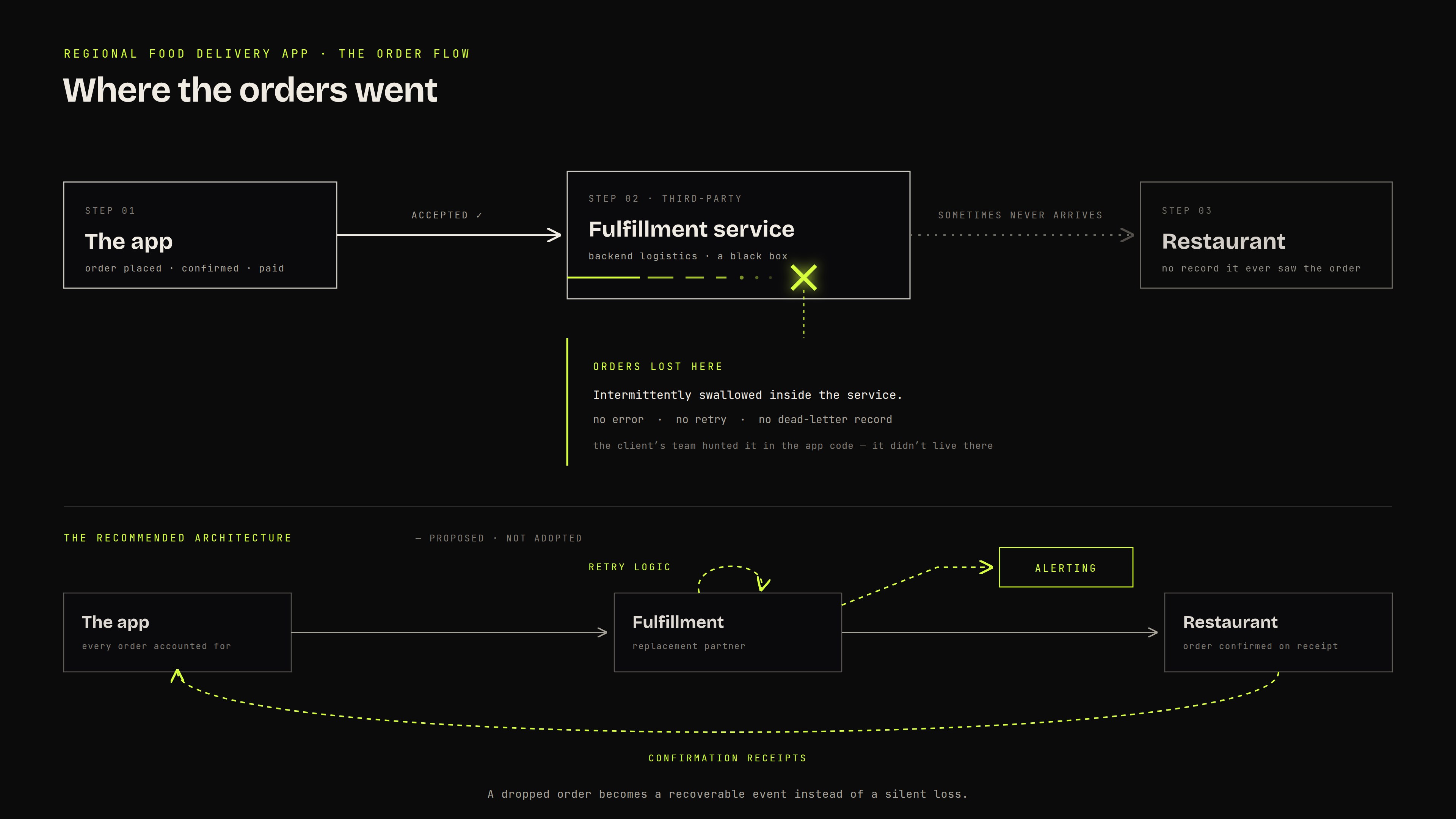
Two patterns surfaced fast. Customer complaints clustered around a specific, strange failure: orders that simply vanished. Placed, confirmed, paid, then nothing. No food, no notification, no record the restaurant ever saw it. And the review scores showed it: the app was averaging 2.6 out of 5, with the angriest reviews all telling the same disappearing-order story.
Here’s the thing about rebranding a product with a 2.6 rating: you’re repainting a car with a hole in the fuel line. The new brand would have driven trial, and the broken experience would have converted that trial into one-star reviews at scale. A better logo was going to make the problem louder.
Strategy
Nobody asked me to debug their platform
But I’ve spent enough years in technical work to know that “sometimes orders disappear” is not a mystery. It’s a reproducible failure that nobody has instrumented yet.
So I instrumented it. I recreated the ordering flow with logging at each hand-off point and ran orders through until the failure showed itself. The pattern was consistent: orders were being accepted by the app, passed to the third-party backend fulfillment service, and intermittently lost inside it. No error, no retry, no dead-letter record.
The orders weren’t failing. They were evaporating. The client’s own team had been hunting the bug in their app code, where it didn’t live.
The work
Diagnosis without a path forward is just bad news
So I researched the backend logistics market and identified replacement partners whose architecture included what the incumbent lacked: order redundancy. Confirmation receipts, retry logic, and failure alerting, so a dropped order becomes a recoverable event instead of a silent loss.
I built a full transition plan and outlined the sequencing, cutover approach, and validation testing against the same logging harness that had caught the original failure. I offered to work directly with the client’s engineering team to execute the migration.
Meanwhile the brand work never stopped. The diagnostic track ran alongside the creative one, not instead of it.
Results
The brand shipped. The migration didn’t.
The complete brand identity package, logo through full rollout, was delivered on the original schedule.
The client elected not to proceed with the backend migration at that time. The rebrand therefore launched onto a product whose core reliability gap remained unresolved.
I still lead with this story, because it’s what I think creative direction actually is. The client asked for a brand. What they needed was for the brand’s promise and the product’s behavior to match. Discovery exists to find the gap between those two things. Sometimes closing that gap means writing a brand book, and sometimes it means standing up a logging harness at 11pm to catch an order in the act of vanishing.
I’d rather be the creative director who found the fuel-line leak than the one who delivered a beautiful paint job on schedule and watched the car break down anyway. This engagement showed exactly that distinction.