Design · Brand · Code · 2025
Know before they go
Tenurly is not a real company. It’s an invented client built to carry a real problem: full positioning, brand and launch campaign for a retention-intelligence startup, plus the discovery finding that the brand was never the thing holding it back.
- Role
- Positioning, brand, campaign, product design
- Year
- 2025
- Client
- Fictional · self-directed
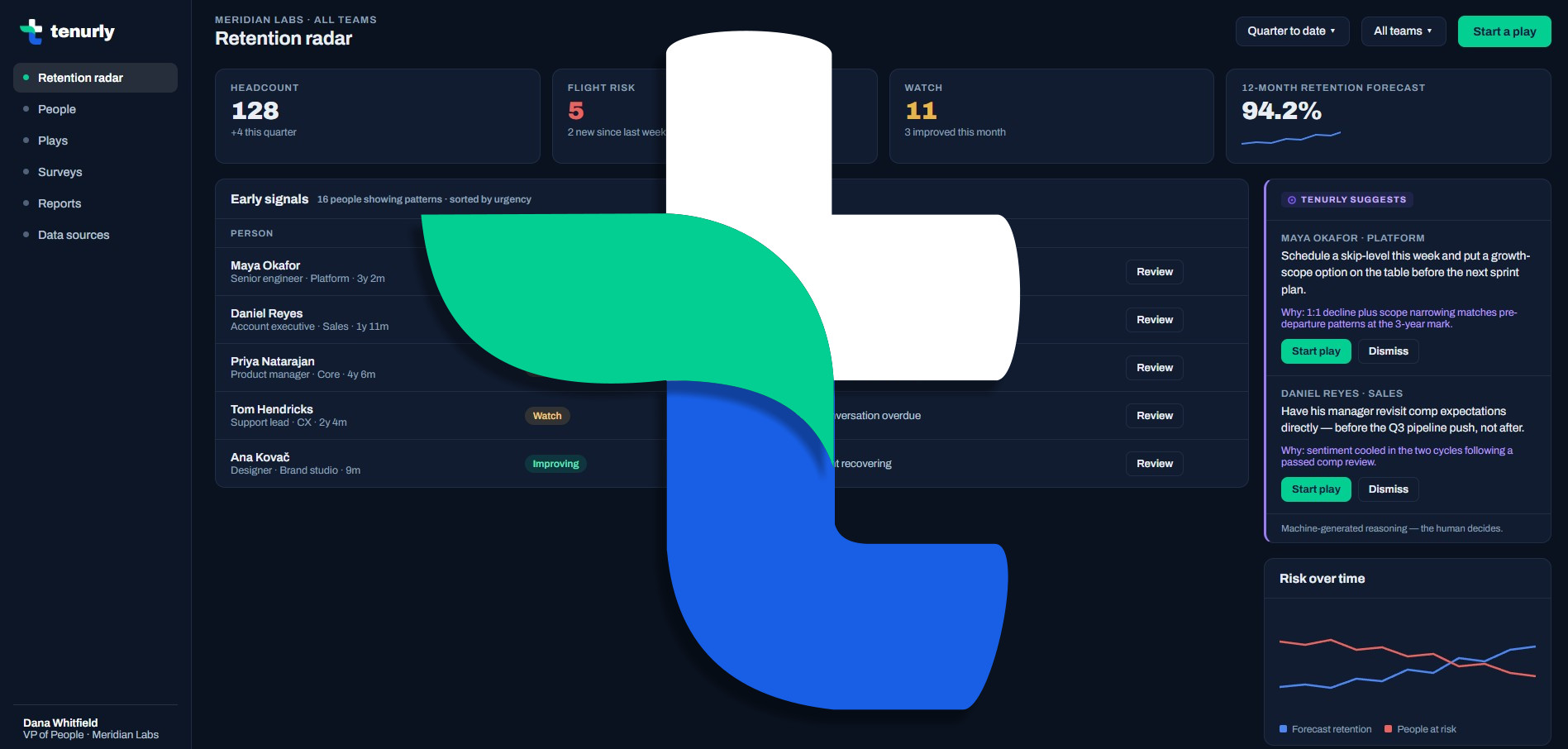
Brief
“We close deals when we get in the room, but nobody knows we exist”
Reminder, because the rest of this section reads like a real client: none of it is. The company below is invented.
Tenurly is a forty-person Series A B2B SaaS company. Its platform ingests HRIS, engagement-survey and manager 1:1 data to flag which employees are at risk of leaving, then tells HR why, and what to do about it, before the resignation letter shows up. Founded by two former HR directors who got tired of exit interviews explaining problems they could have fixed.
Around $3M ARR, trying to get to $10M. The buyer is a VP of People or CHRO at a 200–2,000-employee company; deals run $25–80K a year.
The brief, in the client’s words: “Our current brand looks like a hackathon project; investors have said so out loud. We need a brand and a demand engine that makes a 12-person sales team look like a category leader. Rebrand, new site, and a launch campaign. Six weeks.”
Discovery
Three blockers the brief didn’t mention
The demo is the leak, not the brand. Trial signups go cold because the product dashboard overwhelms first-time users. The brand problem is real; the funnel problem is bigger. Rebranding first would buy more traffic for a door that doesn’t open.
Sales and marketing tell different stories. The deck says “predictive analytics.” The site says “employee engagement.” The founders say “manager coaching.” Three spines, no category.
Their best proof is unused. A retention company’s own customer-retention data, the single most obvious piece of evidence it could own, never appears in its materials.
Strategy
Retention intelligence. Know who’s leaving before they know it.
Positioning. For HR leaders at growing mid-size companies who find out why people quit only after they’ve quit, Tenurly is a retention-intelligence platform that spots flight risk early and prescribes the fix, unlike engagement-survey tools that report sentiment but leave HR guessing at what to do next.
That’s the one spine, and it resolves discovery finding two. Not analytics, not engagement, not coaching: retention intelligence.
Two people have to say yes. Dana, VP of People, 44, reports to the CEO and owns a turnover number for the first time in her career. She fears the blindside resignation and the board asking why attrition is up; she wants to walk into the exec meeting with a forecast instead of an apology. Marcus, HR Ops Manager, 31, actually runs the tools. He fears another platform that promises AI and delivers dashboards nobody opens; he wants something that tells him Monday morning exactly which three managers to call. He evaluates ruthlessly, via free trial, which is precisely where the funnel was leaking.
Three value propositions, one per objection. See it coming: flight-risk forecasting from data you already have (HRIS, surveys, 1:1s). Know what to do: not another dashboard, but prescriptive plays for each at-risk person or team. Prove it worked: retention math a CFO accepts, cost-of-attrition avoided, by quarter.
Tone. Confident, plainspoken, quietly urgent. “Empower,” “engage” and “journey” are banned outright; in a category this fluffy, refusing the vocabulary is the differentiation.
Tagline. Front-runner: “Know before they go.” Short, sticky, and it says the whole product. The runners-up push harder: “Exit interviews are autopsies. Do medicine instead.” · “Your best people signal before they leave. We read the signals.” · “Retention isn’t a mystery. It’s a dataset.”
The work
The Quiet Signals
The campaign. Every departure had warning signs: calendar patterns, 1:1 sentiment, scope shrink, the meeting someone stopped being invited to. The campaign dramatizes the signals everyone missed.
The hero asset does double duty. A Retention Risk Quiz, AI-powered, living on the new site. It's the campaign's centerpiece and the fix for the first discovery finding: it pre-qualifies leads and delivers the aha-moment before the demo, so Marcus meets the value proposition instead of the dashboard. The scope change came out of discovery, not the brief.
Channels, all on the one spine. LinkedIn thought-leadership plus paid; a five-part “signals” email nurture; a sales deck rebuilt to match what the site now says.
Shipped in the engagement. Brand identity and brand book · landing page on Vercel with the AI quiz · five-email nurture sequence with A/B rationale · twelve-post LinkedIn set · ten-slide sales deck · discovery memo · measurement plan · case-study writeup.
Results
Targets, not results, because a concept doesn’t get to have outcomes
This is where a concept study has to be honest. There is no client, so there is no pipeline, no lift, no testimonial. Reporting numbers here would be fabricating them.
What the engagement produced instead is a measurement plan with targets and a way to tell whether it worked: quiz completion rate (target 40%+), quiz-to-demo conversion (target 15%), email open and click-through against B2B SaaS medians, and pipeline influenced. The first live A/B test is already specified (tagline-led against pain-led subject lines) because the strategy makes a claim about tone that deserves to be tested rather than asserted.
What’s proven and what’s assumed. The positioning, the messaging architecture and the campaign hold together as a system, and the discovery finding (that the funnel, not the brand, was the binding constraint) is the kind of reframe that decides whether an engagement is worth its fee. What’s assumed is everything downstream of contact with a real market: that the quiz converts, that the tone lands with a real Dana, that six weeks was ever realistic.