Strategy · AI · Code · 2026
Time Given, Time Taken: the end of the attention race
Attention is the one resource that does not grow, and the cost of shouting for it rises every year. So what happens to a brand that does the opposite — builds somewhere people can go to get their attention back, and asks for nothing? 180 people, two strategies, rules you can inspect.
- Role
- Concept, simulation, code, writing
- Type
- Self-directed experiment
- Stack
- Single-file JavaScript · Canvas
- Method
- Guided experiments; every rule and setting open
The attention race is ending. Here's what replaces it, and why the public is about to expect it.
Before most people have found their slippers, something has already asked for their attention. A notification, a headline, an offer that expires at midnight (it won't, not really, but it would very much like you to believe it will). By lunch they've made dozens of small decisions under pressure, and most of them were about things someone else wanted them to decide. By evening there's nothing left in the tank, and they couldn't tell you where it went if you paid them.
You know this, because you live it too. And if you work in marketing, you also know it from the other side: you're one of the voices in that stream, shouting a little louder every year and getting heard a little less.
I call that stream the feed. I don't just mean a social media feed, though that's certainly part of it. I mean everyday life as it's now lived, with every ad, alert, deadline and prompt elbowing for the same limited attention. This piece is about why the strategy that built the feed is running out of road, and what's replacing it.
The math has changed
Most marketing today runs on a familiar playbook. Get noticed first. Stop the scroll. Pair urgency with some signal that you solve a problem (whether or not you actually do) and lean on fear of missing out to close the gap. Be different enough to break through, but not so different that nobody gets it.
That playbook assumes there's more attention out there to win. There isn't. Attention is the one resource that doesn't grow; everyone gets the same day, no matter how many brands want a piece of it. As more of them pile in, three things happen at once. Getting noticed gets more expensive, because you're bidding against everyone else for the same set of eyes. The bottom of the market floods with cheap, mass-produced content made on the odds that something, anything, hits, which of course makes the noise worse. And visibility settles in with the incumbents who can afford to keep paying for it. That's great news if you're an incumbent and not so great if you're anybody else.
There's a quieter cost, too. Every interruption shifts work onto the person on the receiving end. They have to filter it, which means evaluating it, which means dismissing it, which means finding their way back to whatever they were doing before it showed up. The playbook treats attention as something to take and leaves the customer holding the bill for the taking. People feel it, even if they can't name it. They've learned to scroll past, block and ignore, and now every brand pays for that learned blindness, including the ones that never did a thing to earn it.
The path we set aside
It wasn't always this way. "This program is brought to you by" bought a stretch of someone's time and asked for nothing back but a moment of association. Brand building was patient work. You invested in how people felt about you and waited for it to pay off slowly, the way a savings account does (or did, anyway).
The industry walked away from that for reasons that made sense at the time. Les Binet and Peter Field's research for the IPA showed that long-term brand building and short-term activation behave very differently: activation gives you quick spikes that fade, while brand building compounds over years. Their work suggested most brands should put the bulk of their budget into the long game. Much of the industry, being the industry, went the other way anyway, because activation shows up in this quarter's numbers and brand building doesn't.
Cheap and fast won because it was cheap and fast. It's still fast. It is not, however, cheap anymore, and that changes the calculation considerably.
Quiet spaces
Here's the alternative. Instead of scrapping for a sliver of attention inside the feed, a brand builds a place outside of it: somewhere people can go to get their attention back. That might be sponsored content that stays genuinely, actually ad-free. It might be an activity, an event or a social space that carries the brand's character without selling anybody anything. "This time is brought to you by…" and then, and here's the hard part, the brand keeps its word.
The key ingredient is agency: the freedom to stay, to leave, to do whatever you like, with nothing asked in return. That's exactly what the feed takes from people at every scale, and it's what they remember when somebody finally gives it back. They may forget what an ad said. They don't forget who made them feel better, especially when everything around it made them feel worse.
What makes this credible is a promise, which I think of as the rule of the quiet: no hooks, ever, and leaving is always easy. Restraint is a costly signal, and that's the point. A brand can imitate the look of calm easily enough with soft colors, a little white space, maybe a plant. What it can't fake is the absence of an ask. The moment it slips a pop-up, an upsell or a "before you go!" back in, it has broken the one thing that made the space work, and people feel it right away.
Oh. It's one of those.
Won't this just get gamed too?
Anyone who has spent time around metrics is already raising a hand. If quiet spaces work, then "making people feel better" becomes the next number to optimize, and numbers that become targets get gamed. That's Goodhart's law, and the attention economy is more or less a monument built in its honor: engagement became the target, so engagement got manufactured.
But whether a metric can be gamed depends on the structure around it. Time spent in an app built on autoplay and infinite scroll is mostly time taken; the design quietly removes every moment where you might have decided to stop. Time spent in a space where leaving is effortless is something else entirely. It's a vote, cast continuously. Same number, opposite meaning.
So the test for an honest metric is pretty simple: is leaving free? If it is, optimizing for time spent means making the space genuinely better, because that's the only way left to move the number. Get the structure right and optimization pressure stops being a threat and starts being an engine.
Watching it happen
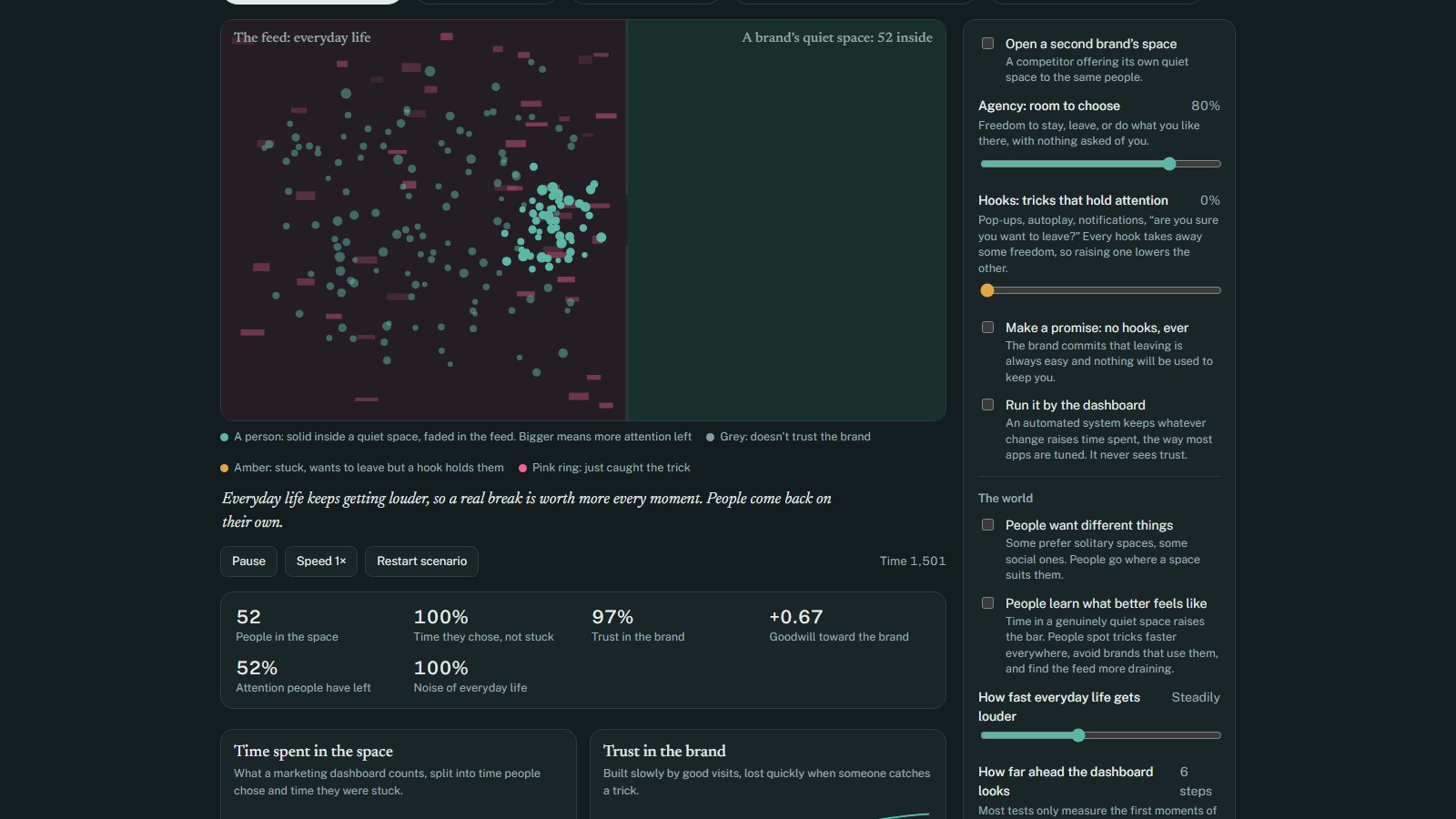
I built a simulation to test all this, because arguments about systems are hard to see and awfully easy to wave off. It's deliberately simple: 180 people moving between the feed and one or two brands' quiet spaces, following a handful of rules anyone can inspect. Everyday life gets louder over time. People visit spaces they trust when they need a break. Real value takes a moment to feel, while hooks work instantly. Trust is built slowly and lost quickly. That's very nearly the whole model, and a few of the things that came out of it surprised me.
The dashboard is the last to know. When a quiet space starts using hooks, time spent goes up and the dashboard says it's working.
Look at that. Nailed it.
Underneath, trust and goodwill are already sliding, and a few hundred steps later attendance follows them right down. Anyone watching only engagement would see a success story until the decline was well underway, and by then the story has a very different ending.
Short-term testing chooses extraction. I handed one space to an automated system that keeps whatever change raises time spent, judged over the first few moments of a visit. That, not coincidentally, is how a lot of real products are tuned. It chose hooks every single time and optimized the space right into collapse. Give the same system the same goal but rule out hooks, and it does the opposite, because the only way left to raise time spent is to give people more room. Stretch out its test window and even the unconstrained system starts choosing room. So short-termism isn't just a cultural failing. It's the specific mechanism that makes extraction look rational.
There's a tipping point, not a smooth trade-off. A space can absorb a little friction and still build trust. Past a certain threshold, though, every visit becomes a small net loss, and the space starts spending down what it built. The decline is slow, and that's exactly what makes it dangerous. Nobody panics over a slow leak until they're standing in water.
Success can be borrowed. A space running a moderate amount of hooks held up for a long time on its own, and the reason was uncomfortable: it wasn't holding people because it was good. It was holding them because everyday life was worse. When a genuinely quiet competitor opened up, the first space lost most of its attendance without changing a thing and without anyone having to distrust it. People simply had somewhere better to go. (Being the least-bad option is a fine business right up until it isn't.)
Being early on the right path is a lasting advantage. A space that got to quiet first held its lead for a long time, even against a later rival that was strictly better, and an equally good latecomer never caught up at all. Being early on the wrong path, on the other hand, bought nothing. The head start of a space that leaned on hooks evaporated soon after a real alternative showed up.
It isn't winner-take-all. When people have different tastes, two quiet spaces with different characters both grow, and more people find a break than either could reach alone. The hardest way in is copying the leader. The easiest is being distinct.
The simulation comes with a guided set of experiments that walk through each of these, and every setting is open to change. I'd encourage you to try to break it. Honestly, I'd like to know if you can.
The expectation is coming
The result I'd most want a brand leader to sit with is the last one I added. In the simulation, when people spend time in genuinely quiet spaces, they learn what that feels like, and their bar goes up. They notice tricks faster, everywhere. They steer away from brands that use them. The feed itself starts to feel worse, because now they have something to compare it to.
Switch that on and everything tightens. A space with a mild amount of hooks, which had held its own for thousands of steps, gets overtaken by a quiet competitor in short order. Even running alone, a space that harvests attention declines far faster, because the good parts of its own space teach its visitors to notice the bad parts. It is, in a sense, training its own critics.
I think this is where the real world is heading, and not by accident. I'll be making the same case to the public: that there's another option, that brands don't have to behave this way, and that people are allowed to expect better. Once people know relief is possible, a brand without it isn't neutral anymore. It's conspicuously absent. It's the misting station that makes you notice how hot the desert is. Before that, it was just the weather.
The practical consequence is that "good enough" has an expiration date. Tactics that slide by unnoticed in a market that doesn't know any better become glaringly obvious the moment it does.
What this doesn't prove
A simulation is an argument you can watch, not a forecast, and I'd be doing you a disservice to pretend otherwise. This one leaves out money, advertising within the feed, targeting and markets with many competitors. The patterns it relies on, that trust is lost faster than it's built and that hooks raise short-term engagement, are well supported. The specific numbers are illustrative, and I chose several of them myself. Where the model shows a threshold, the existence of the threshold is worth taking seriously; its exact location isn't. Every rule is documented, so if you disagree with a result, you can go find the assumption you disagree with.
There are real risks, too. As "brands that care" becomes a category, it's going to attract imitators: calm aesthetics wrapped around the very same funnel. The defense is the same as everywhere else in this argument. People who have felt the real thing are the first to notice the fake.
The opening
The attention race rewards whoever can afford to shout the longest, and the price of shouting goes up every year. The alternative is slower to start and a whole lot harder to fake: give people room, keep the promise and let them come back because they actually want to.
That path is open right now, and very few are on it. The advantage goes to whoever steps onto it first and stays there. Everyone else will have to be clearly, obviously better to catch up, in a market that by then has learned to tell the difference.
Companion pieces. Gradient Walker and Headless are simulations of the same kind, aimed inside the organization rather than at the market: what a company does to the ground it feeds on, and what happens to information on its way to the top.